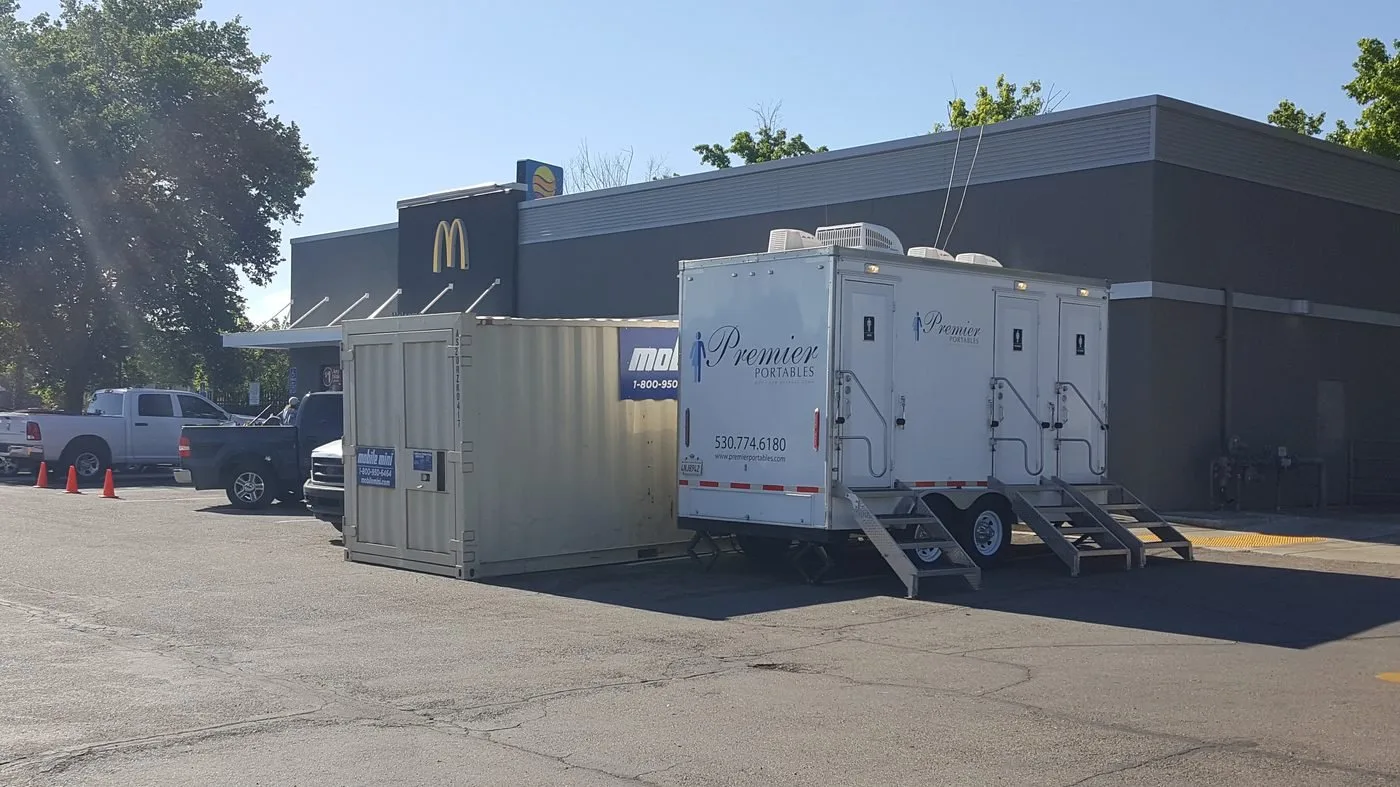
A full McDonald's remodel means the interior is gutted — new equipment, new finishes, new layout. The restrooms go offline. But the drive-thru keeps running, the employees keep showing up, and in some cases the dining room reopens partway through. The operation doesn't stop. The restroom solution can't either.
That's the situation a regional restaurant construction company brought to us — three times, at three consecutive McDonald's locations across Northern California, each roughly a month apart. They'd found a provider they trusted and kept coming back.
Every location got our 3-station restroom trailer. For a restaurant remodel, it's the right call for reasons that matter in practice:
Each trailer connected directly to shore power and water at the site — no generator, no freshwater tank management. Simple, reliable, clean.
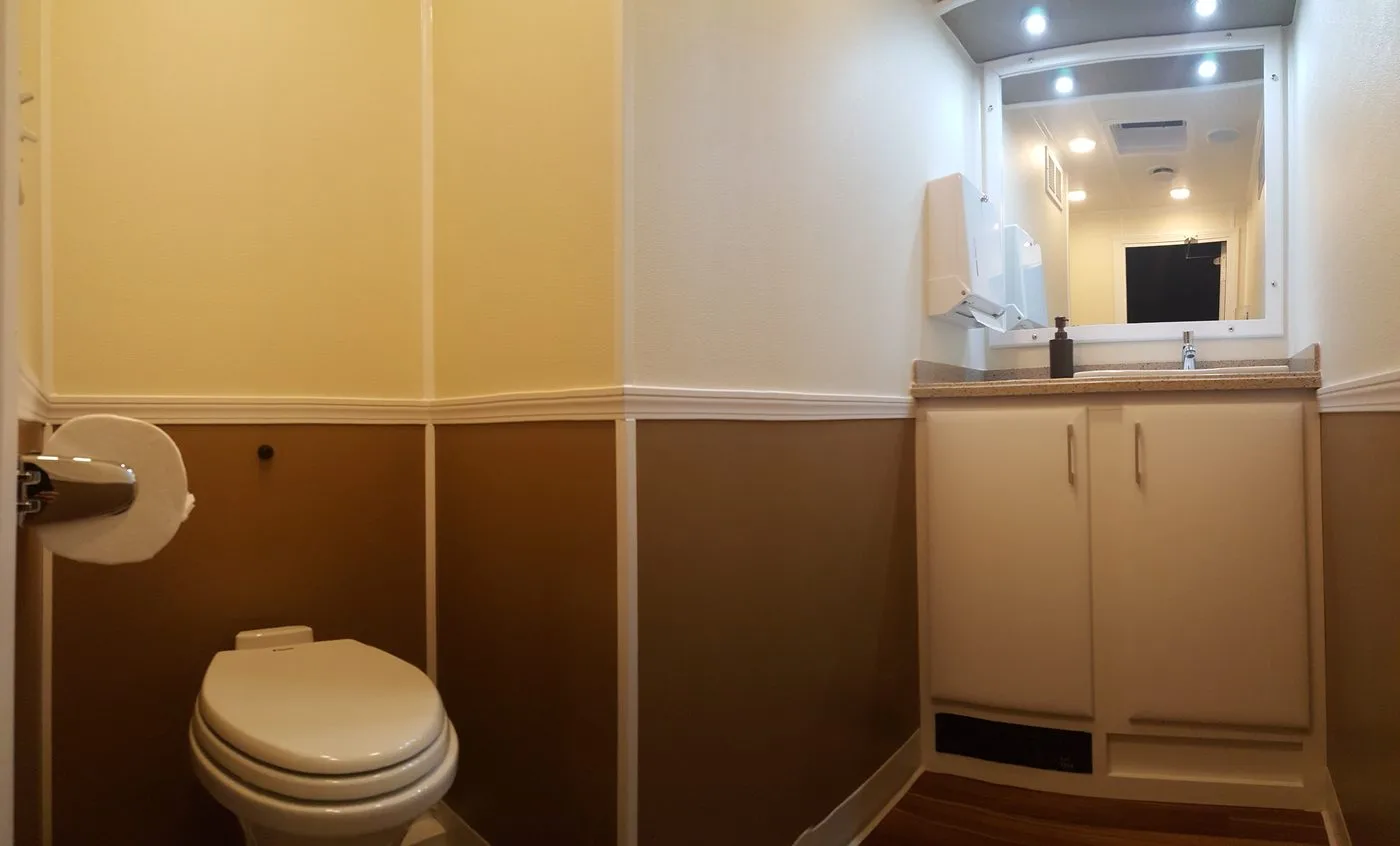
The operational details are where restaurant remodels get interesting. Each location handled differently depending on what was open:
At two of the three locations, the dining room closed completely while the drive-thru continued operating. The restroom trailer served employees only. Each station was kept locked — employees had keys, the public didn't have access. Clean and simple.
At one location, the restaurant remained open to customers at some point during the remodel. Public access to a restroom trailer on a job site requires a system — you can't leave the doors unlocked and unmonitored.
Our standard practice on customer-facing deployments: the trailer stays locked. We provide multiple keys, each attached to a large, hard-to-lose fob — think a big wooden spoon, something that can't slip into a pocket unnoticed. Customers request the key at the counter, use the facility, and return it. It's a simple protocol that protects the trailer, keeps the restrooms clean, and gives the franchise owner control over access without requiring staff to babysit the unit.
It worked exactly as intended.
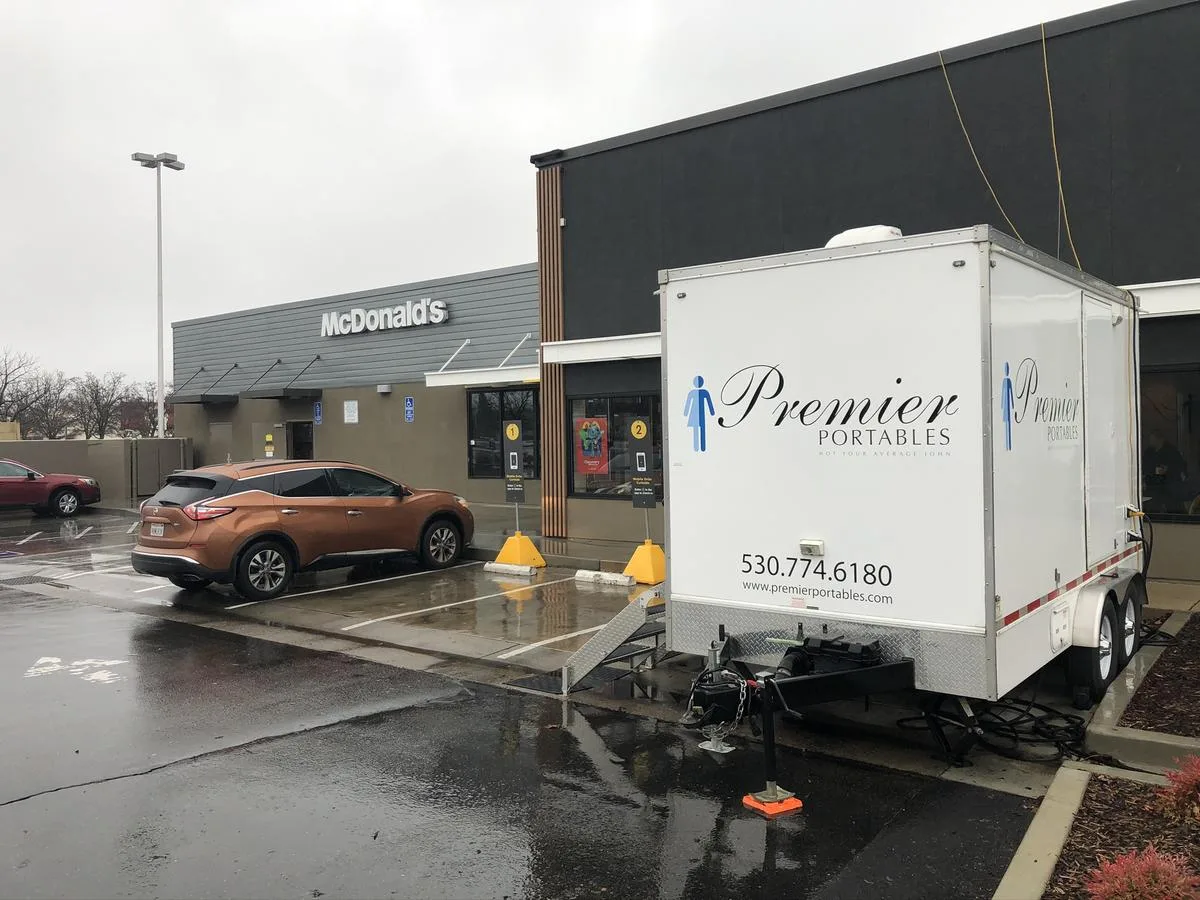
On one site, shore power was available but running a cord across the parking lot or along the ground wasn't an option — a trip hazard on a working commercial site is a liability nobody wants. The solution: we worked with the project manager to route the extension cord up and over the roofline, keeping the ground completely clear. No tape, no cord covers, no workarounds. Just a clean solution that kept the site safe.
It's the kind of thing that doesn't come up in a quote conversation but matters on the day of delivery.
Each of these deployments was straightforward by design. The construction company knew what they needed, we knew how to deliver it, and the franchise owners at each location had one less thing to worry about during a disruptive remodel. When you're managing a full restaurant gut on a live commercial property, the last thing you need is a restroom vendor who creates problems.
We didn't create any. Across three locations, three remodels, and several months of combined deployment — zero issues.
That's why they called us three times.
Yes. When a restaurant remains partially open during a remodel, a trailer can serve both employees and customers. We use a key-management system on customer-facing deployments — the trailer stays locked, keys are attached to an oversized fob, and customers request access at the counter. It keeps the facilities clean and controlled without requiring staff to babysit the unit.
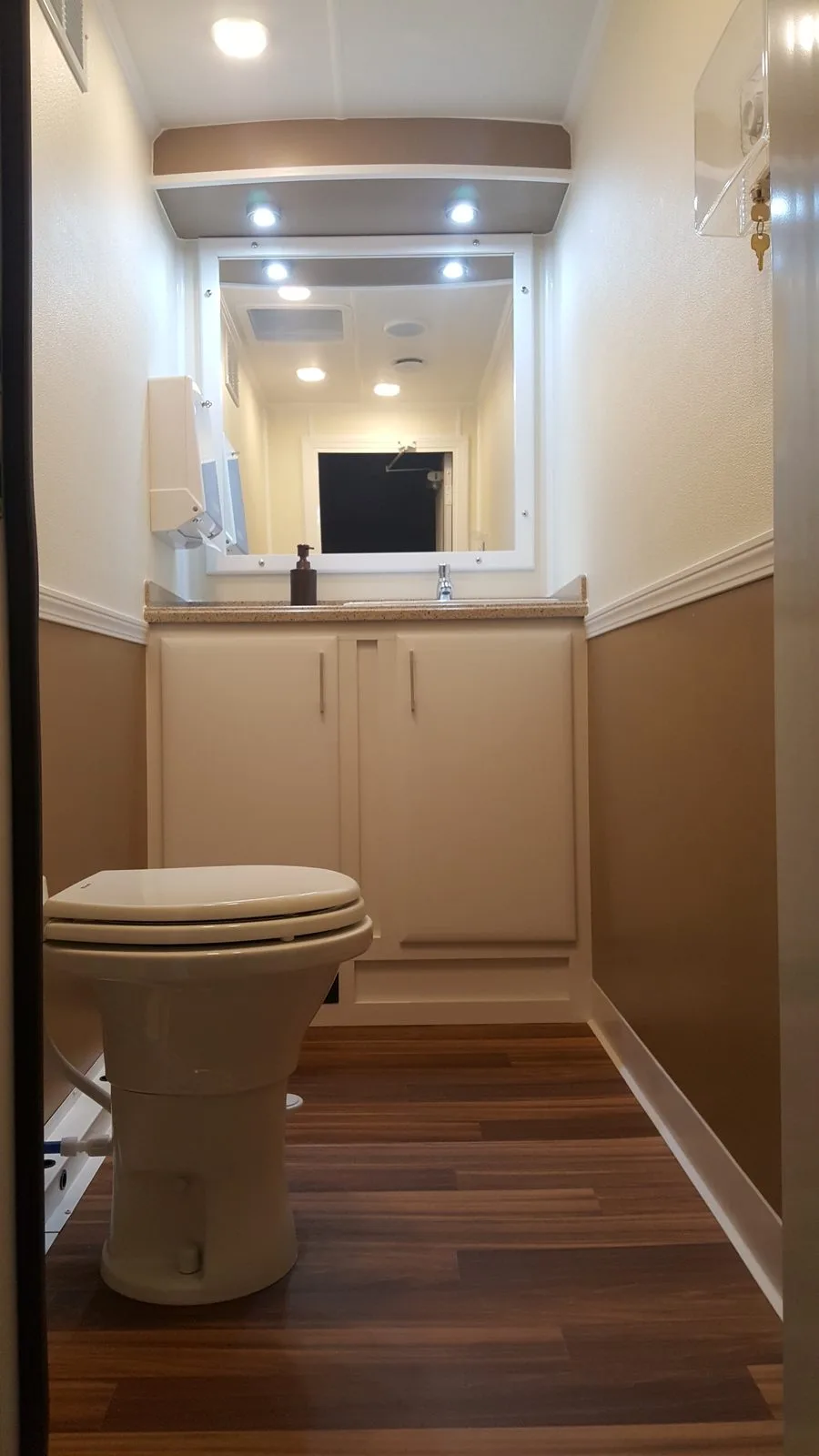
For most restaurant remodels, a 3-station trailer is the right fit. Each station is a fully private, self-contained room with a locking door, hot water, and climate control — appropriate for both food service employees and the public. The private individual rooms also make access management simple when the site is partially open.
Yes. Hot water is standard — it's essential in any food service environment where employees are required to wash their hands regularly. A cold-water-only unit isn't appropriate for a restaurant deployment.
Pumping and maintenance is provided on a scheduled basis — typically twice weekly on a restaurant remodel. Daily cleaning and restocking is generally handled by the client, keeping operational costs straightforward. For projects requiring full-service daily support, that can be arranged separately.
On one location we designated one of the three stations for employees only and the remaining two for customer use. Each station has its own locking door, so separating access is straightforward — employees had a key to their designated room, customers requested keys for the other two at the counter. It kept both groups comfortable and the facilities organized throughout the remodel.
RV-style toilets in restroom trailers are different from residential toilets — they don't have the same water volume per flush, so they require different handling when clogged. We include a clearing rod at every toilet so users can simply push contents straight down into the holding tank. We also provide written instructions inside each unit on proper use and how to clear a clog. It's a simple fix when you know what to do — and making sure users know is part of how we prevent unnecessary service calls.
Yes, and on restaurant remodels this is usually the cleanest solution — no generator noise, no freshwater tank management. On one of these deployments, we routed the power cord over the roofline rather than across the ground to eliminate a trip hazard on the active site.
| Location | Trailer | Operation | Access |
|---|---|---|---|
| Location 1 — Northern California | 3-station, hot water | Drive-thru only | Employees only, locked |
| Location 2 — Northern California | 3-station, hot water | Drive-thru only / partial reopening | Employees + customers, key system |
| Location 3 — Northern California | 3-station, hot water | Full remodel | Employees only, locked |
We know how restaurant remodels work — the drive-thru stays open, the employees keep showing up, and your restroom solution needs to be invisible. Call Ron directly and we'll have you set up before your GC breaks ground.
916-538-9044